The Von Der Becke Academy Corp · Storm Lake, Iowa
We don’t lower the bar.
We raise the student.
A K–12 school where students advance when they have proven mastery — not when a calendar says so. Individualized instruction, character taught as coursework, and a Taekwondo discipline framework that makes every standard something earned.
- In Storm Lake since
- 2020
- Years here
- 6
- Grades
- K–12

Mastery
not seat time
Already enrolled?
Students and parents sign in here
Everything for enrolled families — daily check-in, the school day, and your student’s progress — lives in the School Day app, using the same sign-in your student uses. This site is just for enrolling.
Not enrolled yet? Start an application instead.
Our mission
Every student, held to the same standard
Differentiation happens in the path, never in the destination.
The Von Der Becke Academy Corp exists to develop whole, capable, and confident human beings by holding every student to the highest academic and character standard — providing every resource and individual support needed to reach it, while never lowering the expectation.
How a day actually works: the Whole–Part–Whole cycle
Every subject runs on the same repeating cycle. No concept is withheld from a younger student, and no student is left working alone on something they have not been taught.
- WHOLE
Group Concept Introduction
All cohort members receive instruction on a high-level concept simultaneously. No concept is withheld from younger or earlier-stage students.
Purpose: Establishes a shared high standard, exposes all students to aspirational content, and activates curiosity and forward orientation.
- PART
Individual Micro-Instruction
The instructor works with each student individually on the specific skill components within the concept that are at their current mastery level.
Purpose: Ensures every student receives instruction matched to their actual ability, filling gaps without removing the student from the group environment.
- WHOLE
Group Reconvene & Demonstration
Students reconvene approximately every hour to demonstrate progress, apply the concept in context, and witness their peers' demonstrations.
Purpose: Reinforces learning through demonstration, builds a community of mutual respect, and allows the instructor to assess progress and recalibrate.
Read the full instructional framework, subject scope, and mastery assessment method on the curriculum page.
What we believe
Six convictions that shape everything
These are not slogans. Each one changes something concrete about how instruction is delivered and how students are assessed.
The Standard Does Not Move
Differentiation occurs in the path, not the destination.
Academic and behavioral standards exist to be met — not adjusted to the student's current comfort level. Every student works toward the same high academic goal. Instructional scaffolding, task analysis, and individualized pacing provide every student the specific support needed to reach the standard, ensuring that no student is left behind and no standard is diluted.
Mastery Before Progression
Students advance when they can demonstrate mastery — not when the calendar says so.
This mastery-based progression model, grounded in Applied Behavior Analysis, ensures that every student builds on a foundation of genuine competence. Complex skill demonstration is accepted as evidence of simpler constituent skill mastery, eliminating redundant remediation and honoring students' actual knowledge.
True Confidence Is Earned
A belt is not given. It is earned through demonstrated performance.
The VA School teaches a deliberate distinction between true and false confidence. True confidence emerges when knowledge is applied through sustained practice until it becomes skill — and that skill is owned, not borrowed. False confidence is the assumption of competence without practice. Students are not praised for passive reception of information, but for demonstrated application and mastery.
Pivotal Behavior as Foundation
Behaviors that generalize across every environment, taught as academic subjects.
The VA School prioritizes pivotal behaviors — behaviors that, once established, produce broad positive outcomes without requiring skill-by-skill remediation. The three domains are self-control, self-awareness, and strength of character. They are taught as academic subjects, reinforced individually, and assessed as part of the graduation standard.
Adversity as Instruction
We do not shield students from difficulty. We coach them through it.
Every challenging situation, academic or behavioral, is treated as an instructional opportunity. Staff are trained to engage adverse moments in real time, guiding students to identify what occurred, why, and how to transform the experience into a positive outcome. This produces students who are resilient, reflective, and capable of growth under pressure.
Discipline as Respect
Discipline is not punishment. It is the highest form of respect for a student's potential.
The Taekwondo framework provides students with a visible, structured path of earned progression, a code of conduct grounded in timeless values, and a physical practice that develops mental clarity, focus, and physical confidence. Students understand that every expectation placed upon them communicates belief in their capacity to meet it.
These convictions are expressed day to day through five values drawn from the traditional Taekwondo tenets — see the full philosophy and values.
Character as coursework
Three pivotal behaviors, taught and assessed like any subject
Pivotal behaviors are the ones that, once established, generalize across every environment — so they do not have to be re-taught situation by situation. Each is graded on a five-point generalization scale and each is required to graduate.
Self-Control
The student manages emotional responses, resists peer pressure, and responds constructively to environmental influences.
Practiced daily through structured scenarios, coached in real time during challenges, and demonstrated through observable behavior change.
Self-Awareness
The student knows where they are, what they are supposed to be doing, and what their current emotional and physical state is at all times.
Developed through structured check-ins, reflective practice, and environmental orientation training.
Strength of Character
The student maintains their values, commitments, and belief structure through adversity, peer influence, and personal challenge.
Developed through deliberate exposure to difficulty with coaching support, and affirmed through the Taekwondo value framework.
When a student struggles, the response is instructional rather than punitive — no exclusionary discipline, no shame-based correction. See the behavioral framework in the handbook.
How students are grouped
Four cohorts, placed by readiness
Cohorts are not strictly age-based. A student is placed by their current academic and developmental stage, which is what makes individualized pacing possible in the first place.
Kindergarten – Grade 4
Early
Foundational literacy, numeracy, behavioral skills, and introduction to all discipline areas.
Grades 5 – 8
Middle
Expanding knowledge across all content areas; developing independent learning habits and pivotal behaviors.
Grades 9 – 12
Upper
Advanced academics through the highest achievable level in each subject; college and career preparation; Taekwondo mastery.
Post-diploma, ages 16–18
Higher Institute
Career field immersion, credentialing, advanced academic pursuit, and capstone completion.
Scope of instruction
A full academic program, taken as far as each student can go
Every core subject is taught to the highest level the student can reach — not to a grade-level ceiling.
Core academic subjects
- Mathematics
- Arithmetic through advanced mathematics — algebra, geometry, pre-calculus, calculus, statistics.
- Science
- Life science, earth science, physical science, biology, chemistry, physics.
- English Language Arts
- Reading, writing, grammar, composition, literature, rhetoric.
- Social Studies
- History (U.S. and world), geography, civics, economics.
Enrichment & applied subjects
Not electives at the margins — these are scheduled, assessed, and required for graduation.
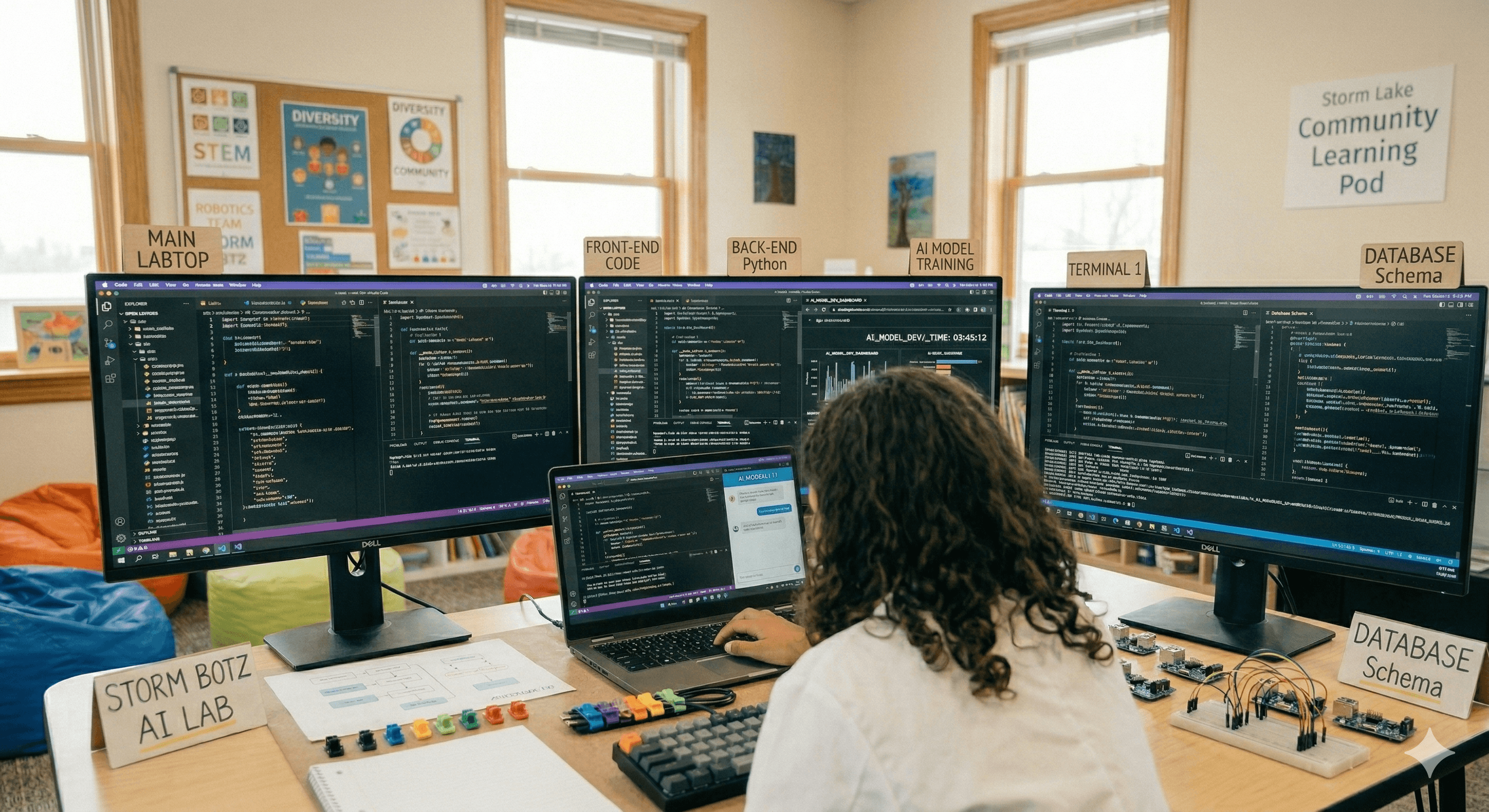
Computer Science & Coding
Programming fundamentals, software development, AI concepts, robotics.
Leadership Development
Communication, decision-making, team leadership, ethical reasoning.

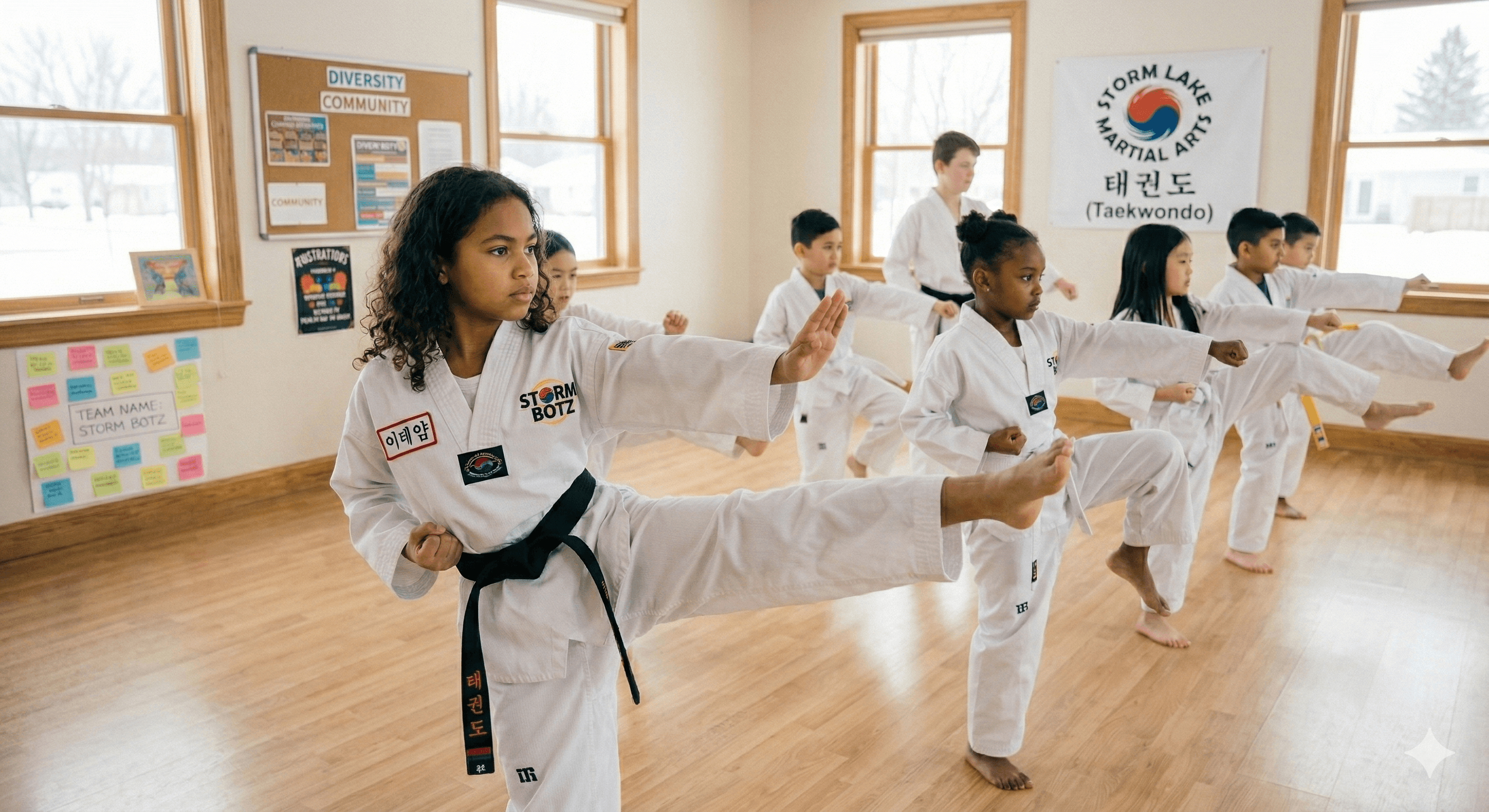
Taekwondo
Physical conditioning, discipline framework, self-defense, rank progression.

Clinical Mental Health Literacy
Emotional regulation, mental wellness, self-advocacy — embedded through the ABA pivotal behavior curriculum.
Graduates who want professional preparation before adulthood continue into The VA Higher Institute — two years of supervised career immersion with up to 30 college credits.
Tuition & Iowa ESA
What enrollment costs
$200per student / month
Covers extracurricular activities and supplementary programming.
Iowa Education Savings Account
~$8,000 per student per year
Paid directly by the Iowa Department of Education ESA program upon school accreditation and family enrollment.
Admissions
How to enroll
Submit an enrollment application
Complete the Family Enrollment Agreement online. It takes about fifteen minutes.
Intake meeting with the Head of School
We discuss your student's history, your goals, and exactly what the school expects of families and students.
Initial student assessment
Informal and observational. It places your student in the appropriate cohort and establishes a baseline for progress monitoring — it is not a test to pass.
Enrollment confirmed
Confirmed upon receipt of the signed Enrollment Agreement and the first monthly contribution.
Not ready to enroll?
Homeschool with us behind you
A step between homeschooling alone and enrolling at The VA School. You keep teaching your own children; we hand you the curriculum, the standards, the app our students use, a teacher who answers when you are stuck — and a place in the dojo.
$20 per child per month. You keep teaching at home; we supply the curriculum, the app our students use, a teacher to ask, and the grading — and your child can train Taekwondo at the dojo if you are close enough to get here. Iowa ESA funding does not apply to this tier — ESA follows an enrolled student. If ESA matters to your family, full enrollment is the path.
See Homeschool at HomeWhat it costs
$20per child / month
Billed monthly. No contract, no enrollment, cancel by telling us.
Ready to raise the bar?
Enrollment is open. Start with the application, then meet with the Head of School — we will tell you honestly whether this is the right fit for your student.